ANATOLIA INTERNATIONAL FILM FESTIVAL


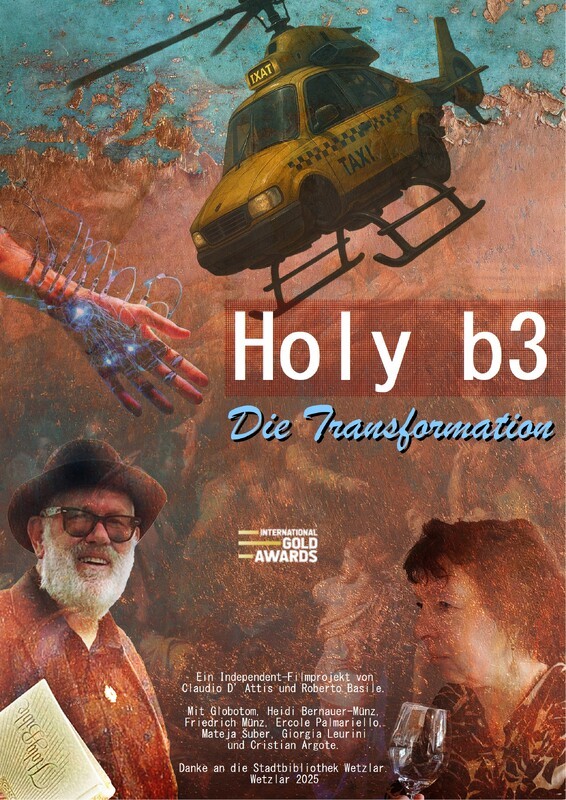


Holy -B3 Die Transformation
by Claudio D´Attis
"Imagination is more important than knowledge.” Albert Einstein
The film opens with an aphorism drawn from Einstein: “Because knowledge is limited, imagination encompasses the entire world, encourages progress, and gives birth to evolution.” Building upon this premise, Claudio D’Attis’ work transcends the boundaries of a dystopian science fiction narrative, positioning itself instead as a philosophical meditation on the intersection of belief systems and technological advancement. While it foregrounds the friction between artificial intelligence and religion, the story also unfolds into a broader exploration of individual freedom, collective ethics, and spiritual transformation, weaving these themes with both rigor and poetic subtlety.
Holy -B3’s story begins in the German city of Wetzlar. In the story, Father Haase criticizes the “digital slavery” of young people's addiction to smartphones. To free young people from the bondage of technology, he decides to seek help from other technologies. The film can also be read as a cinematic response to the problems that plague people today, such as distraction, social isolation, and perception management brought about by the digital age. There is no doubt that there is a problem, but Haase's misguided rescue project is actually a modern reflection of traditional discourses that demonize technology. In this context, the character of Doctor Frau, with whom Father Haase enters into a relationship, also shows how science and technology can degenerate into a blind instrument of power. While all this is going on, another center, reminiscent of the TV series Person of Interest, observes the events and shares them with the priest in Siene, creating an allegory in which technology and the view of God are equated. Technology here takes on the role of both a punishing and a redeeming force. The nun in Siene uses technology's information-providing aspect to act for the good of humanity. The idea of resurrecting the dead through technology, which is central to Haase's salvation project, stands at the intersection of ancient religions' teachings on death and rebirth and the digital fantasies of immortality. The debate over whether the soul is reduced to the body or to information becomes a thought-provoking theme here. The film brings one of today's most pressing ethical debates to the cinematic stage. Artificial intelligence can analyze sacred texts, spread teachings, and even support religious practices. However, there are also risks such as the displacement of the concept of God and the prioritization of “algorithmic ethics” over spiritual values. At this point, the film offers both a warning and a hope: if faith is combined with wisdom and ethics, artificial intelligence can remain at the service of humanity. Dr. Frau's transformation through faith in the end and his eventual killing of Haase imply that science and faith do not have to clash, but can instead build a better future together. Channeling technology toward a “bright” future is one of the film's most striking themes. This scene shows that scientific progress is not doomed to soulless mechanization, but can instead be integrated with human values. Science is not the opposite of religion, but can complement it.
The film introduces the vision of a “techno-spiritual utopia,” where religion is no longer set in opposition to technology but is instead absorbed into it, with sacred texts reimagined as guides for shaping the moral fabric of the digital age. Holy-B3 Die Transformation unfolds in a universe painted with shadowed palettes and animated by next-generation technologies. The intensity of drone attacks, cyborg youths, and robotic armies is counterbalanced by moments of spiritual illumination, creating a visual cadence in which tension and transcendence alternate, inviting the audience into intervals of reflection.
AIFF