ANATOLIA INTERNATIONAL FILM FESTIVAL


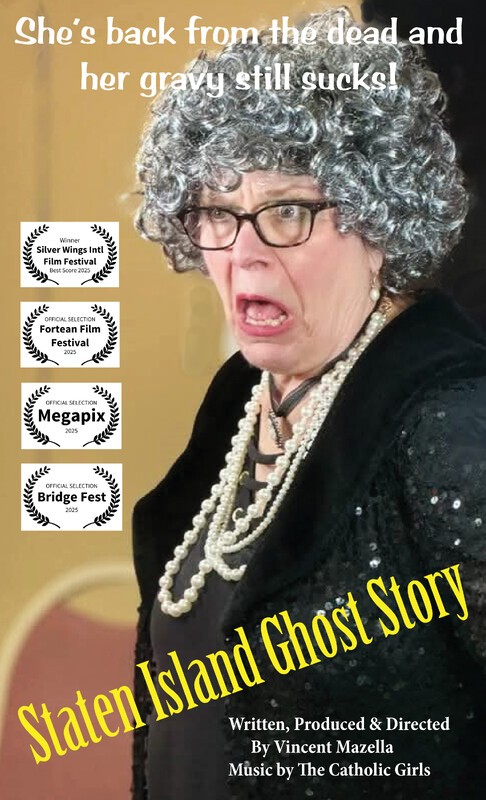
Staten Island Ghost Story
by Vincent J. Mazella
Review
"“A created thing is never invented and it is never true: it is always and ever itself.”” Federico Fellini
If the movie Staten Island Ghost were a universe, its creator would be Vincent J. Mazella. Not only did he write the screenplay, but he also directed, produced, and embodied one of the leading roles, Vito Aventura. The film’s DNA carries his signature in every frame. The plot is essentially constructed as a parody of successful Hollywood horror films. From beginning to end, it is crowded with references, winks, and cinematic allusions. Staten Island itself—often associated in local New York culture with haunted houses and unsettling events—becomes a fertile backdrop for the film’s hybrid parody. It is also no coincidence that Staten Island recalls Italian mafia clichés, immortalized by films such as The Godfather and Donnie Brasco. The name of the protagonist, “Vito,” inevitably recalls Vito Corleone, and the Aventura family’s Italian-American identity underlines the intertextuality Mazella is pursuing.
The narrative, however, is deliberately flimsy. Vito and his wife Gina Aventura, together with Gina’s son Bruno Bottoms from a previous marriage, plan to leave Staten Island for New Jersey. Vito’s grandmother Fortuna resists, not wanting the family to break apart. She attends the farewell party only to exit dramatically, cursing them as she leaves. What follows unfolds in the new house, purchased at a suspiciously low price due to its sinister history. The previous owners, the Yutz family, vanished without explanation. Yet the Vito family shows little concern, wandering through the house with the naïveté of Little Red Riding Hood. Naturally, they stumble upon horror staples: a Ouija board, tarot cards, and a cursed tape recorder ominously marked “steal me or die.” Predictably, they play the recording, unleashing a spectral energy that infects the family. Gina is struck by the Ouija planchette and soon possessed—a parody of iconic scenes from The Exorcist and Witchboard. What follows is a knowingly exaggerated series of possession tropes, with Gina writhing in bed, fixated on cauldrons like a witch concocting spells.
The film’s humor is eccentric, often pushing parody into absurdity. At its best, it captures the manic energy of a spoof; at its weakest, it feels like disjointed sketch comedy. The script gestures toward multiple satirical avenues—Italian mafia references, occult clichés, haunted-house conventions—but too often leaves them half-developed. For instance, the mafia motif is abandoned almost immediately, and the tarot cards become decorative props rather than vehicles for comedy. Structurally, the film resembles a sitcom, confined almost entirely to the family’s house and relying on repetitive setups rather than escalating comic tension.
Technically, the production falters. Lighting is uneven, frequently casting confusing shadows and leaving actors’ faces obscured. Camera placement and framing often fail to capture expressions, undermining comic timing and emotional beats. Cinematographer Kelly Meagher’s work unfortunately weakens the film’s visual impact, preventing the parody from achieving the polished absurdity it seems to aim for. On the other hand, sound design emerges as the film’s strongest technical element. Danny Krastek’s award-winning sound work provides both texture and atmosphere, elevating scenes that visually fall flat. The original song “Down At the Shore,” written by Gail Peterson and performed by The Catholic Girls, stands out as an inspired addition, lending the film a quirky charm it otherwise struggles to sustain.
Ultimately, Staten Island Ghost Story reflects Vincent J. Mazella’s undeniable passion for filmmaking. It brims with ambition and cinephilia, but its shortcomings—inconsistent acting, fragmented narrative, and technical missteps—hold it back from realizing its full parodic potential. It is a film that entertains with its sheer audacity, even as it stumbles in execution.
AIFF